Punta Cana's beaches: the sand is free, the day out is not
The sand is public property. The day out is a business.
Ley 305 of 1968 placed the maritime zone — the band of shore measured inland from the high-tide line — in public hands, and the position it takes is absolute: that ground cannot be sold, and no owner may turn it into private land. Read the depth as roughly the first 200 feet back from the water. Whatever any brochure on this coast says, no development owns a beach here, and none can hand you one.
What can be owned is everything immediately behind that band, and along this shoreline nearly all of it is: the road in, the parking, the path through the palms, the showers, the kitchen, the shade. So a beach here comes in two halves under two different kinds of title — a public half you may stand on by right, and a private half that determines whether standing there is any pleasure. A listing's beach access is a claim about the second half only. It has a price precisely because the first half is free to everybody and therefore organised by nobody.
What a beach club is, once you list its parts
Take the glamour out of the phrase and a beach club is a short list of dull, expensive things, each solving a problem you notice only when it is missing. Somewhere to leave the car, near enough that the cool bag is not a hike. A gate, with somebody at it. Shade that survives wind, which is why a serious operator builds thatched palapas instead of putting out parasols. Fresh water to rinse in and somewhere to change into dry clothes. A kitchen, so that lunch is not a decision about driving home. Loungers that were set out this morning. And, least romantically of all, somebody whose working day starts at first light: clearing what the sea left overnight, raking the sand level, checking the palms.
That last item explains why two neighbouring stretches of one beach can look nothing alike on the same morning. The difference is rarely the sea. It is a machine, a crew and a start time, and all three belong to whoever runs the club rather than to the coastline. So when a development tells you it has beach access, every useful follow-up question is about that operator.
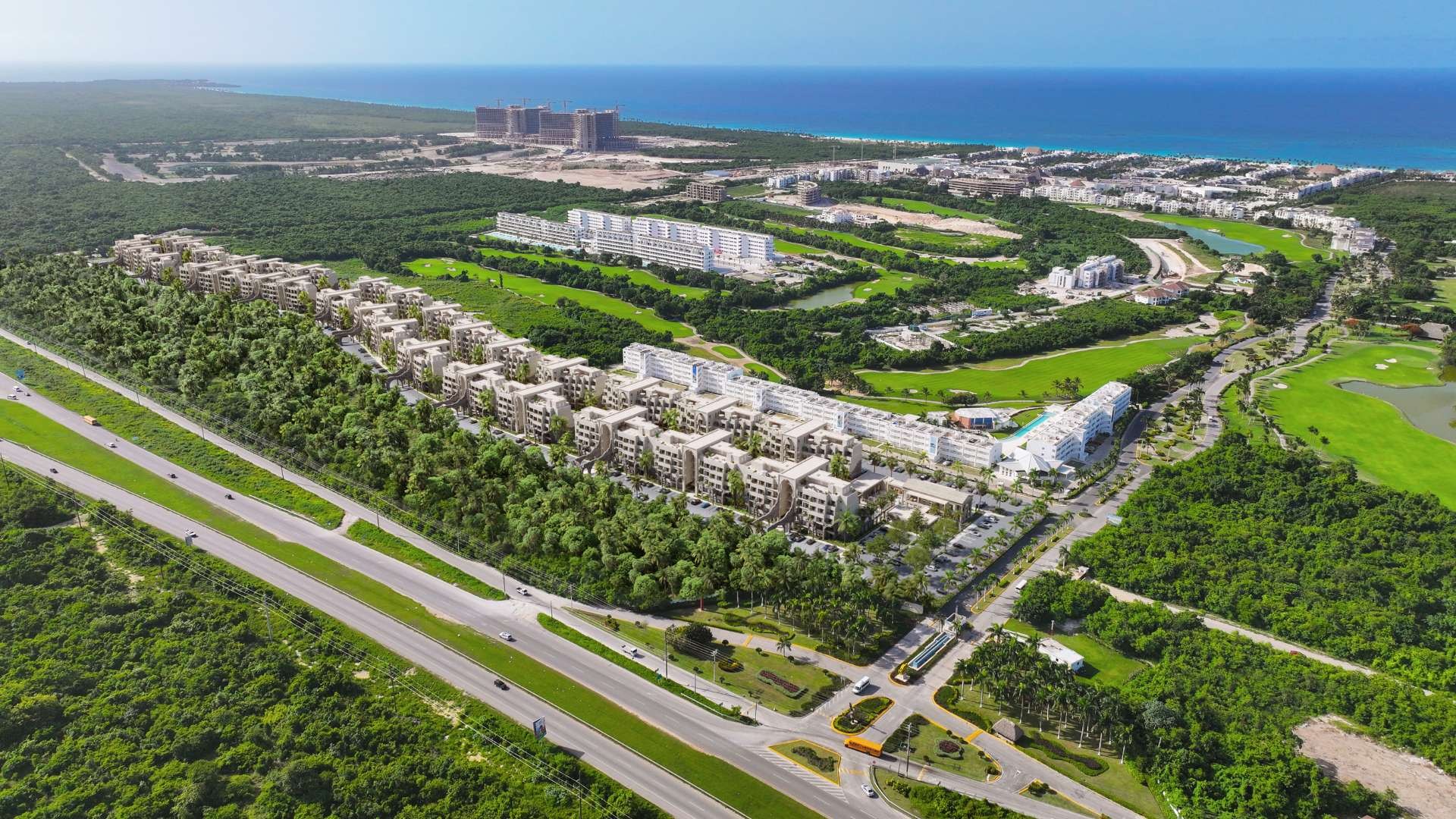
Arena Gorda, and what kind of beach it is
The stretch Cana Bay opens onto is Arena Gorda, on the upper part of the Punta Cana shoreline — south-east of Macao, north of the El Cortecito and Bávaro end where the strip turns into a town. Its name points at the sand rather than at the water: a broad beach with a pale, firm surface, wide enough that the tide line and the tree line are a proper walk apart, and solid enough to be run on and ridden along rather than only sat on. Behind it stand the all-inclusive resorts, which is what keeps the stretch serviced.
It is also the more open end of this coast, and that is worth knowing before you arrive expecting a swimming pool with a horizon. More wind reaches it, and the water carries more wave than the sheltered coves further round the cape; board, kite and wind sports go where that is true, and parents of very small children usually go where it is not. Neither is a flaw. They describe a beach you walk, ride and play in rather than a flat wading shelf — and a buyer who knows which of the two they were picturing has made a better decision than one who read “white sand” and stopped there.
Five minutes rearranges what a beach day is
A visitor has one week and treats the beach as an event: the whole day, the bag, the booking, the sun-cream campaign. An owner 5 minutes away ends up doing something quite different, and it takes about a month to work out what. The beach becomes short and frequent. Forty minutes at seven in the morning, while the water is still glass and the loungers are stacked. An hour before dinner. A swim, a walk to the end and back, home. Nobody packs for that.
The corollary deserves saying plainly, because it is where listings oversell. A beach 5 minutes away is a journey, not a doorstep, and the water you use most is always the water you can reach barefoot. At Poseidonia that means the pools — the community publishes 20+ of them across the site — and the sea stays the reason you chose the coast rather than the thing you do on a Tuesday. Anyone who tells you that ratio runs the other way has not lived at an inland address.
What the beach actually costs once you live here
The sand costs nothing. The chair under the palm is a business, the plate of fish is a business, and reading a Dominican bill properly saves an argument. Expect two lines beyond what you ordered: ITBIS, the value-added tax, at 18%, and a service charge of 10% — the propina legal — which is added to a restaurant bill as a matter of course rather than offered as a choice. It is not a tip in the sense a North American visitor means. Reporting is consistent that it does not reliably reach the person who carried the plate, which is why something left directly is still customary on top of it.
The other cost is the one nobody prints. A club's condition is an operating budget, renewed every year: shade breaks in storms, machines age, sand crews get trimmed. Before buying anywhere on this coast on the strength of a beach club, ask who operates it, how it is funded year to year, whether your access belongs to the residence or to you personally, and what happens to it as the community grows. An amenity in a rendering is a promise. An amenity in a budget is an amenity.
What this means if you are buying at Poseidonia
Poseidonia is a community of 1,319 residences inside gated Cana Bay, priced from $179,000, with delivery projected for 2028. It is not a beachfront address and this page will not pretend otherwise: Arena Gorda is about 5 minutes away, Punta Cana International Airport about 25, and downtown Punta Cana about 17. What the address does carry is resident access to the Cana Bay Beach Club and a beach whose character is worth choosing deliberately rather than discovering on arrival.
Hold on to one distinction while you look at the pictures. The beach club and the Jack Nicklaus golf course are photographs — built, open, with people on them this week. The residences are drawings, and delivery is projected for 2028. That is an unusually good position for a pre-construction buyer, because the part of the proposition you cannot control — whether there is a working community around you — is the part you can already drive to and stand in. Go to the club on your site visit. Order something, read the bill, watch who rakes the sand, then decide.
Common questions
- Can you walk to the beach from Poseidonia?
- Treat it as a short drive rather than a walk. The community publishes about 5 minutes from the door to Arena Gorda, which in practice means a car or a cart, a parking decision and a return trip. That is ordinary on this coast — most residential addresses sit inland of the resort frontage, and the sea is reached rather than stepped onto. Ask for a door-to-door time to the specific entrance you would use, and check it yourself on the day you visit.
- A listing says “private beach”. Is that a real thing in the Dominican Republic?
- Not as a matter of ownership. Under Ley 305 of 1968 the shore above the high-tide line — roughly the first 200 feet — is public property and cannot be sold or converted. What the phrase actually means is that a club controls the land behind the sand: the gate, the parking, the loungers, the bar. That control is real, and it is what you are paying for. It is simply not title to the beach, and nobody on this coast holds that.
- What should I ask about the beach club before I buy?
- Four things, in this order. Who operates it. Whether resident access attaches to the residence or to you personally. What guests and short-term renters are entitled to. And how the club is funded from year to year. The first three decide whether you can use it the way you are imagining; the fourth decides what condition it will be in when you do. None of them can be answered by a rendering, so put them to the sales team in writing and keep the reply.
- Why does a beach-club bill have extra lines on it?
- Because two of them are standard here rather than a mistake. ITBIS, the value-added tax, runs at 18%, and a service charge of 10% — the propina legal — is added to restaurant bills as a matter of course rather than left to the customer. Neither is negotiable at the table. Reporting is consistent that the service charge does not reliably reach the individual server, so many people still leave something directly on top of it.
- Is Arena Gorda good for swimming with small children?
- It is the more open end of the coast, so it generally takes more wind and more wave than the sheltered coves further round the cape, which is exactly why board and kite sports gravitate to this stretch. Families do swim here, on the right day and with the usual care. But if what you pictured was a flat wading shelf, look at the water on the morning you visit rather than trusting any page, this one included — and remember that the calm water at this address is the pools.
Want the details for your own situation?
Ask about availability, layouts or the buying process, and someone from the sales team will get back to you.
Get in touch