Downtown Punta Cana: what it is, and why an owner uses it
Arrive on a package holiday and Punta Cana looks like a coastline with hotels along it. Stay longer, or buy here, and a second version of the region surfaces — the one where a prescription gets collected and a bank form gets signed. Much of that second version is gathered into one district on Avenida Barceló, in Bávaro: Downtown Punta Cana. For a guest it is optional. For an owner it is the part of the map that quietly does the work.
Why a resort coastline built itself a downtown
Punta Cana grew outward from tourism, and for years the day-to-day machinery of living was handled inside the hotels or not at all. Then the population that keeps the resorts running, and later the population that bought homes beside them, needed what a town normally supplies: somewhere to bank, somewhere to see a doctor, an office to sign papers in, shops that sell school shoes rather than souvenirs.
Those functions could have scattered along the highway one plot at a time. Instead a district was set out for them away from the sand, with parking, plazas and units leased to businesses rather than hotels. Seeing it as deliberate infrastructure — a region deciding it intended to be lived in — explains more about this coast than any list of shops could.
What is actually in the district
The district mixes formats rather than committing to one. Part of it is an enclosed, air-conditioned shopping mall, which in this climate is a real point and not a detail: an errand run in August is a different errand indoors. Around and beside it sit street-level plazas and standalone units you reach from the parking, so you can leave the car once and walk between the two. What the combination holds is the ordinary mix of a small city center — restaurants and cafes, retail, a supermarket, a cinema, banking, pharmacies, consulting rooms and clinics, gyms, and the offices of the professional services a household eventually needs. Groceries, a phone contract, an optician, a barber: the unglamorous half of a week.
What the district holds shifts as tenants come and go, which is why this page names categories instead of businesses. Any specific shop, brand or restaurant you read about online — here or anywhere else — is worth confirming on the ground before you build a plan around it.
What changes the day you stop being a guest
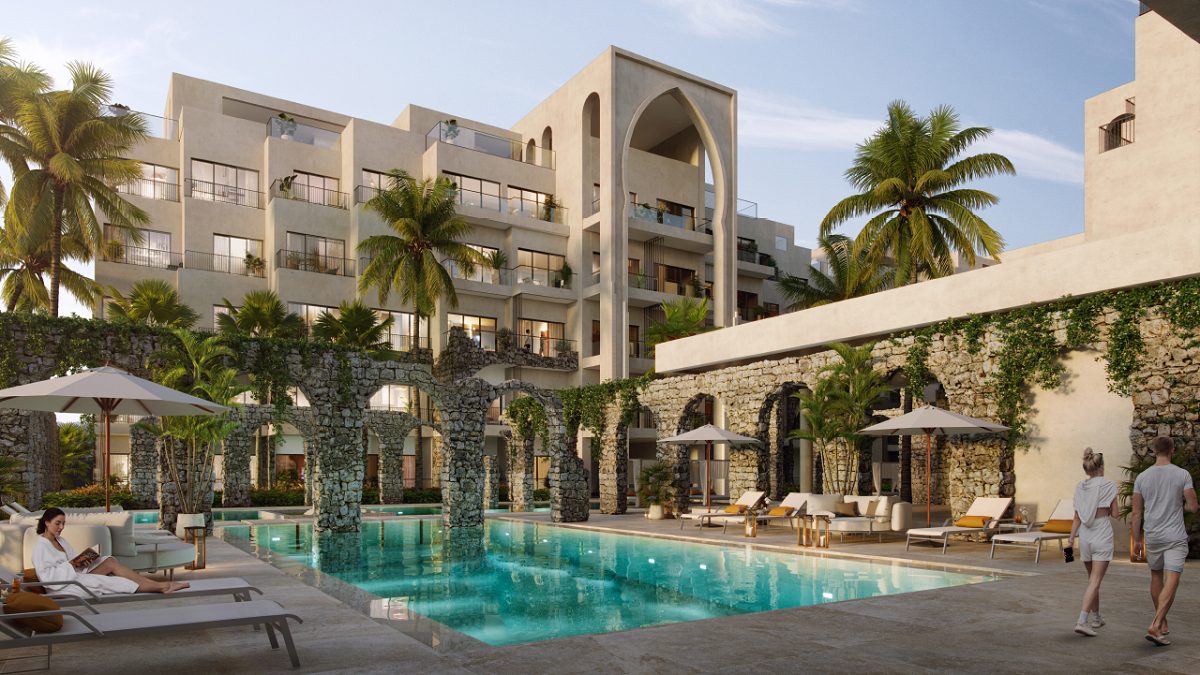
A guest's needs are met inside the property they booked. An owner's are not, and the gap shows up in the first week of actually living somewhere. Poseidonia is a community of 1,319 residences in Cana Bay, with delivery projected for 2028, and a population that size works through the same ordinary list everyone does: appointments, paperwork, prescriptions, presents, haircuts, a document signed in front of a notary.
The site itself covers the pleasant half of that life: golf, pools, the beach club, the gym. The other half happens off site, and a district that gathers it into one stop is worth more to a resident than any single attraction. It is also the difference between a place you visit and a place you can be based, which is the question most buyers are really asking when they ask what there is to do here.
How it differs from the beach strip and the airport road
Three parts of this region get confused because all three have shops in them, and they run on different logics. The beach strip is organized around visitors: its hours, prices and rhythm follow arrivals and departures. The airport road is transport and business infrastructure — car rental, freight, offices, the traffic of getting people in and out.
The downtown district is built on repetition. Its customer is somebody who will be back next week and the week after, and that changes what opens there: a bank branch needs regulars, a pharmacy needs a catchment, a cinema needs an evening audience that lives nearby. So a district built for repeat custom signals a maturing residential market better than another beachfront terrace, and it deserves an hour of a buyer's site visit.
The honest limits: what Downtown Punta Cana is not
It reads as recently built rather than inherited. There is no colonial square, no cathedral, no crooked street that has stood for centuries. If what you want from a Caribbean town is history underfoot, the Zona Colonial in Santo Domingo is the place that has it, and that is a destination you travel to rather than something that opens at the end of your street.
It is also a driving district, not a walkable city. And it does not replace the rest of the region — the beach strip still holds the bulk of the seafront dining, and plenty of practical tasks are settled closer to home. Read it as one useful center among several and it will meet the expectation it can actually meet.
Common questions
- Is Downtown Punta Cana a real town center?
- It is a genuine district with a name, an address and daily footfall, but it is not an old town grown from a historic core. Treat it as the region's practical center — the place that handles what a resort cannot — rather than as a historic quarter, and it will not disappoint you.
- Will the guests renting my residence ever go there?
- Many will not, and that is fine: a short holiday rarely leaves the coast. It matters for the ones who stay longer — families, remote workers, repeat visitors — who need a supermarket, a pharmacy, a cinema or somewhere to be on a gray afternoon. Having somewhere to send them widens the kind of stay your residence suits.
- Do I need a car to use it?
- It is designed around driving and parking rather than around walking in. Taxis and ride-hailing apps work across the corridor, so a car is not the only option, but plan on some form of wheels for the weekly shop and the appointments.
- I want colonial streets and history. Is Punta Cana wrong for me?
- Not necessarily, but be clear about which need is which. This coast offers new construction, beaches and golf; historic architecture is the Zona Colonial in Santo Domingo, and that is a trip you take rather than a neighborhood you live in. Buyers who sort that out before they arrive tend to be happier with what they bought.
Want the details for your own situation?
Ask about availability, layouts or the buying process, and someone from the sales team will get back to you.
Get in touch